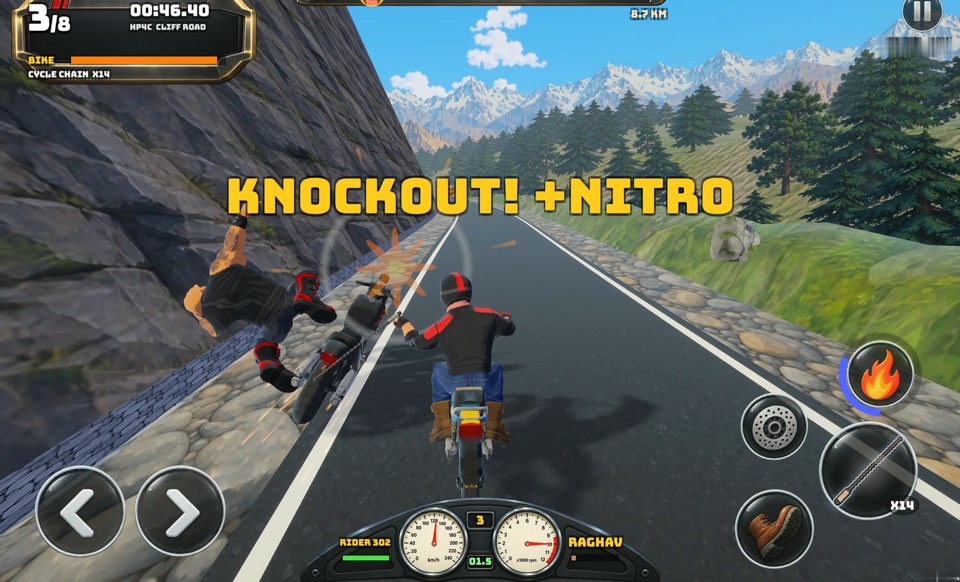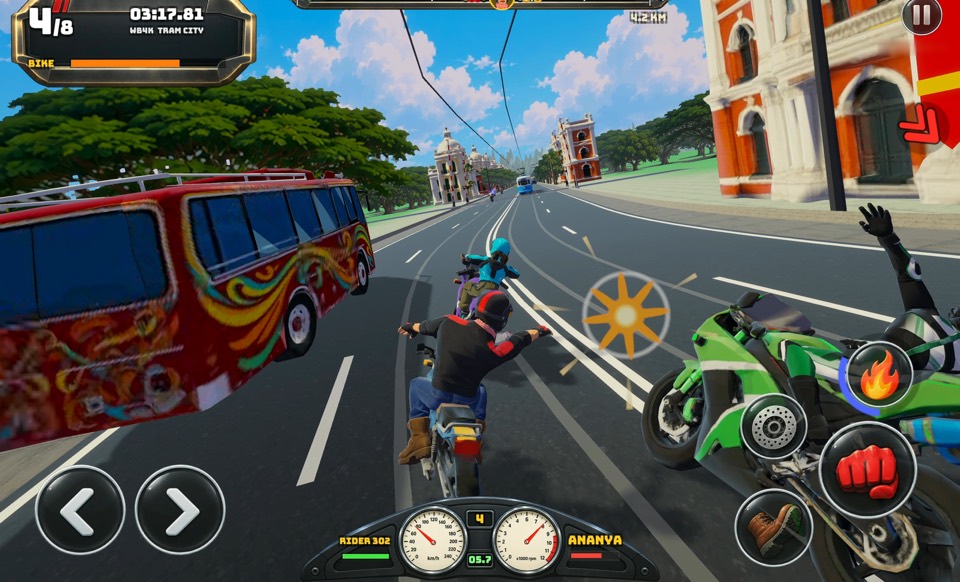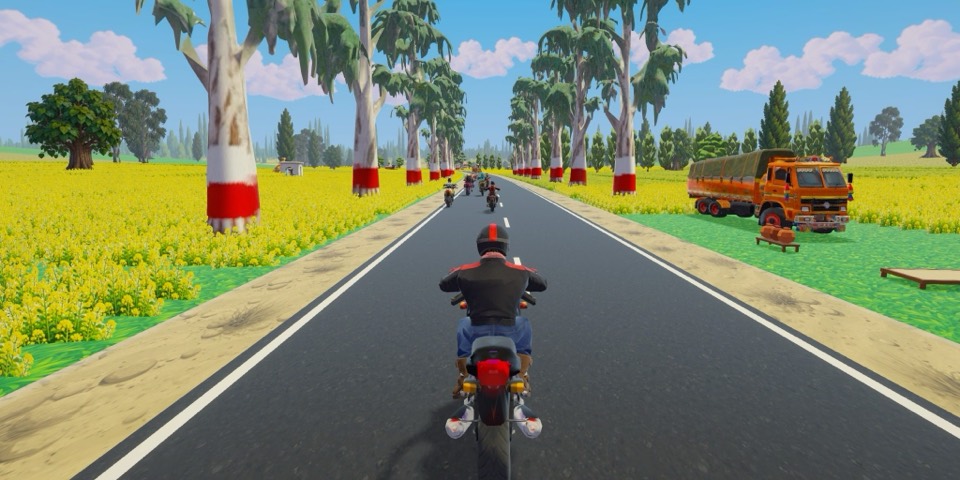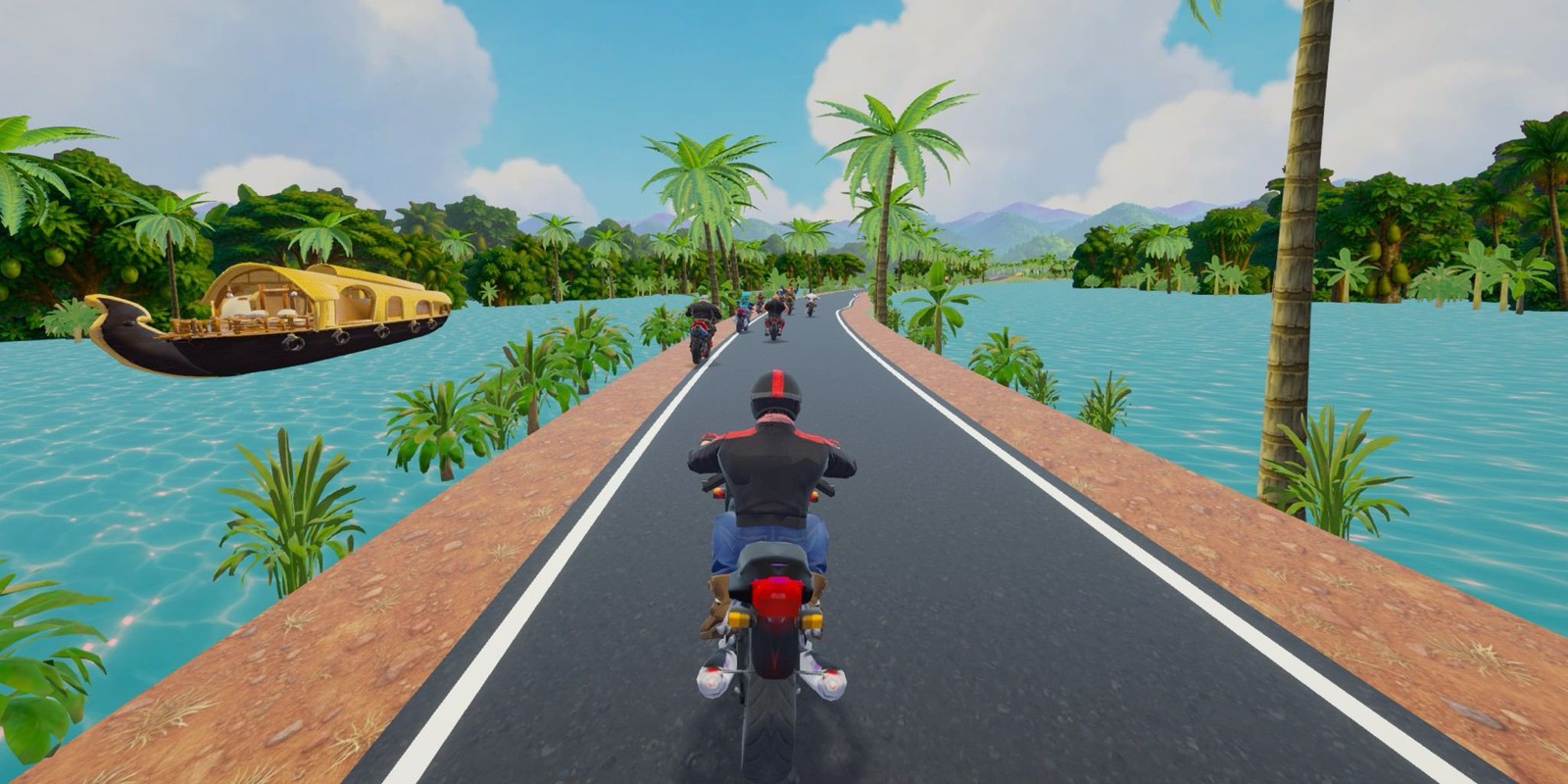
Close your eyes at an Indian roadside and you can tell where you are: horns, engines, a pressure cooker somewhere, a temple bell. Sound does a lot of quiet work in Sadak Fury, so here is how ours is put together.
Engines made in code
The engine sounds aren't recordings played back. They're built live in code, so they can follow the revs, the gears and the throttle exactly:
- RAT bikes putt like a single cylinder.
- SPORT bikes have a lumpy twin's thump.
- SUPER bikes howl like an inline-four.
- The Kaala 750 gets its own V-twin beat, because a drag cruiser should sound like one.
You also hear the bikes around you, the five nearest (three on the lowest graphics level), with the pitch rising as they come and falling as they pass. Every gear change dips and pops, and the rev needle on the dash follows the same automatic 5-speed gearbox.
Our first engines sounded thin. The playtest note: "high or sharp." We retuned them against recordings of real bikes until they sat lower and fatter.
Counting you in
Every race starts with a countdown on the chenda, the big drum of Kerala's temple festivals: one strike for each number. Then GO, with a clean start tone over a deep boom and a cheer from the crowd.
The GO sound has a history. The first version used a horn blast, and it got one of our favourite pieces of feedback: "sounds like a rickshaw horn, not a racing game." It was replaced.
Music for every state
The menus have their own track, and the countdown is silent so the drum can speak. When the race starts, each state's own music kicks in: Indian fusion, dhol and rock, with two rock tracks for West Bengal. The results screen plays a win, a loss or a busted tune.
The sounds of a fight
The fight sounds went through a listening test. We played the current sound and a new take side by side, at the volume you hear in the game, and picked by ear. Eleven sounds were swapped: nitro, the police whoop, the chain, the umbrella, the stick, the bat, the kick, the body thud, the crash, the splash and the crowd's whoop.
When the police turn up you hear a whoop, and the nearest cop within 160 m has a siren that moves around you as he does.
The everyday road sounds include about seventy recorded effects, among them three real Indian street honks. You'll know them when you hear them.
Made for phone speakers
Most players will hear Sadak Fury through a phone speaker, which mainly plays the middle of the sound range. So every clip is balanced for that band, and the important sounds, like hits, warnings and engines, cut through even on a cheap speaker.
There was also one embarrassing discovery: on one phone, the game was playing all its audio at half the quality it should, because the sample rate was set too low. It's fixed at full quality now on every device.
Feeling it: vibration
On Android phones, Sadak Fury uses vibration too:
- a short buzz when you're hit, and a longer one for a heavy hit
- a double thump when you crash
- a steady rumble while you scrape along a wall
- a light rumble when you leave the road, except on the off-road bikes, which take it in their stride
- a thump over speed breakers
The vibration started out too gentle. "It vibrates in settings but I didn't feel it when playing," a tester told us, so the pulses got stronger, and the scrape and off-road rumbles were added.
Turn it up
All of this has its own volume slider in the settings: music, effects and engine, separately. And if you'd rather hear it than read about it, the gameplay reel on the home page is a good start. It's even better with headphones, once the game is out.